Understanding the AVB Domain
What is an AVB Domain
The official definition of 'an AVB Domain' is found in 802.1BA-2011 section 6.4 'Detection of AVB domains'. It cannot be reproduced here due to copyright, but if you have a copy of 802.1BA-2011 at hand, check section 6.4. It's succinct and clear.
In our own words:
AVB systems utilise several different protocols that make up the AVB suite. Two of these are the Multiple-Stream-Reservation-Protocol (MSRP - part of 802.1Q), and the Generalised Precision Time Protocol (gPTP - 802.1AS).
Both MSRP and gPTP have a concept of a 'domain'. Therefore in AVB systems we have an MSRP domain and a gPTP domain.
The MSRP domain is an area of the network within which reservations for streams can be made, and across which streams can flow.
The gPTP domain is an area of the network within which nodes can be time-synced together using gPTP.
Often the MSRP domain and the gPTP domain cover the same area of the network, but not always.
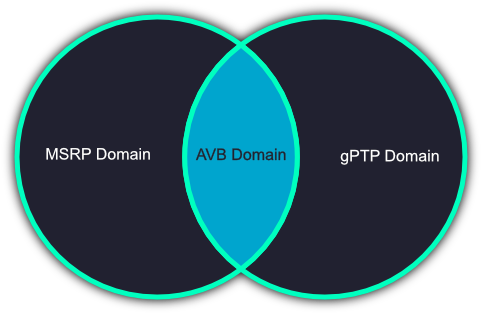
An AVB Domain is the area of the network where an MSRP domain and a gPTP domain intersect.
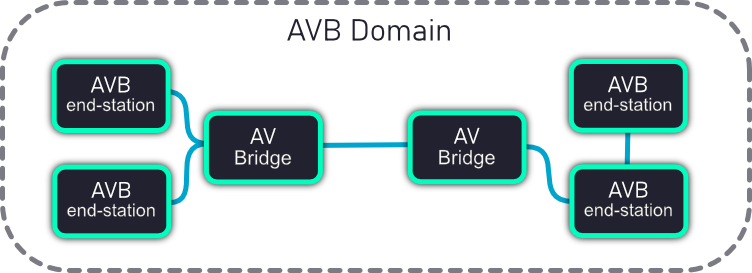
If every device on the network supports AVB, it can form a single AVB domain.
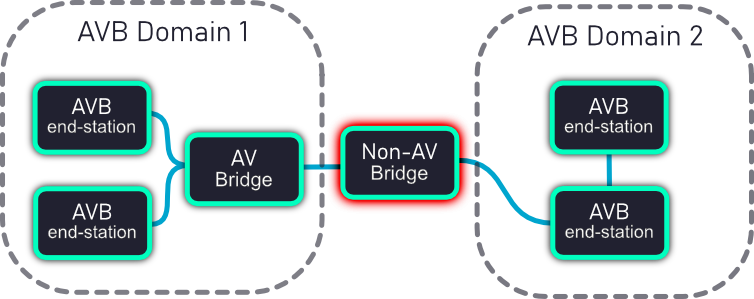
If a part of the AVB network is separated by a non-AV bridge, that part of the network becomes a seperate AVB domain.
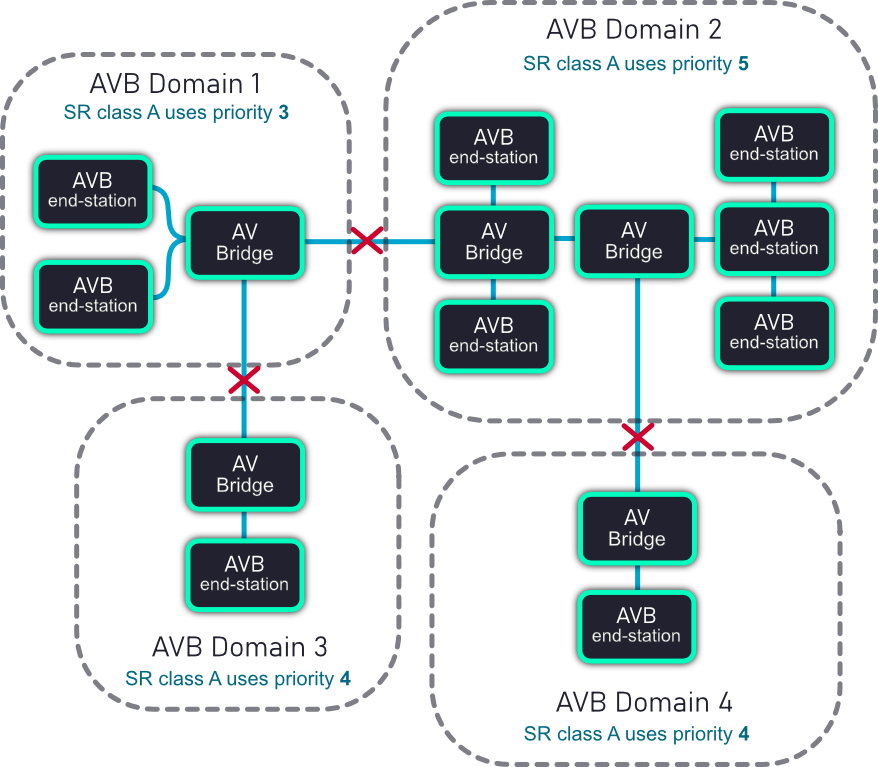
Areas of a network can also be divided into seperate AVB domains by the priority associated with SR class. The example below shows where difference in priority prevents AVB streams being shared between AVB domains.